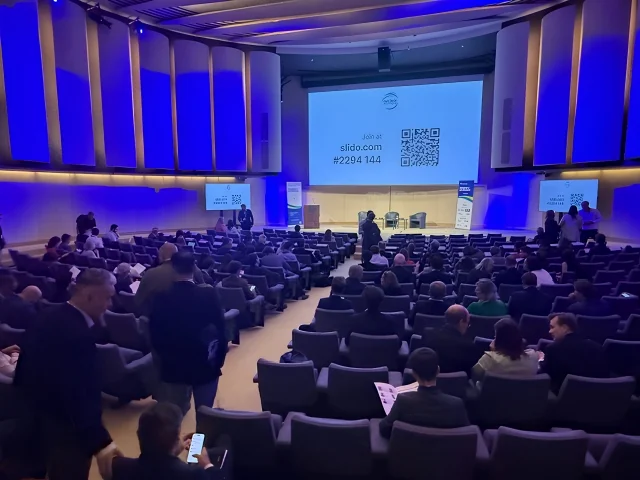

The findings were presented at Gastech 2026, held in Bangkok, Thailand, in September. The assessment examined the economic viability of nuclear-powered LNG carriers under several scenarios involving costs associated with greenhouse gas (GHG) emissions regulations. It found that nuclear propulsion could reduce total cost of ownership (TCO) by up to 15% compared with conventional LNG-fuelled carriers.
The study focused on an LNG carrier with a cargo capacity of 174,000 cubic metres, assuming the installation of an HTGR with an electrical output of approximately 20–25 MWe being developed by Blossom Energy. The assessment considered factors including reactor dimensions and refuelling intervals.
The TCO analysis covered the vessel’s entire lifecycle, based on assumptions including entry into service in 2040, a 25-year vessel lifespan and a discount rate of 5%.
Although the initial capital cost of a nuclear-powered vessel was estimated to be approximately 2.5 times that of a conventional LNG carrier, nuclear propulsion could reduce fuel costs and expenses associated with GHG emissions.
Under scenarios incorporating costs arising from GHG regulations, the nuclear-powered vessel achieved TCO savings of up to 15% compared with its conventional counterpart.
However, without GHG-related charges, the study found that nuclear-powered vessels would struggle to achieve TCO competitiveness at the currently assumed cost of a first-of-a-kind (FOAK) reactor.
Further cost reductions would therefore be needed through measures such as reactor mass production, design standardisation and vessel designs optimised for nuclear propulsion.
The study also explored a business model in which the reactor would be treated as a long-term energy asset, rather than simply as a component of the vessel. Under this concept, a reactor could be removed from a vessel at the end of its service life and installed in another vessel for continued use. The potential for such reuse was incorporated into the assessment of the reactor’s residual value.
Reducing GHG emissions has become a major challenge for the international shipping industry. In July 2023, the International Maritime Organization (IMO) adopted a revised strategy targeting net-zero GHG emissions from international shipping by or around 2050.
Blossom Energy said it would use the findings to continue examining technical and regulatory issues aimed at improving the economic competitiveness of HTGRs.